
Pulaski County Parole vs Probation
Parole and probation can both place a person under the Missouri Department of Corrections Division of Probation and Parole, but they begin in different ways. Parole follows a prison term and lets a person serve part of the remaining sentence in the community under conditions set through the state process. Conditional release is also a supervised release from prison under Missouri law. Probation is a court disposition. A person on probation may never have entered a state prison, and time spent in the Pulaski County Jail does not by itself show which form of supervision followed.
The court record helps explain the legal path. Missouri law allows imprisonment, a fine, a suspended imposition of sentence with or without probation, a suspended execution of sentence with probation, and detention as a condition of probation. That range is why a jail exit, a sentence entry, and the start of supervision are separate events. The state active-offender record can then show whether the person has an active field or institution assignment.
| Supervision | How it begins | Best verification route |
|---|---|---|
| Probation | Ordered by a court as part of a criminal disposition | Case.net judgment and MODOC active-offender search |
| Parole | Granted by the Missouri Parole Board after prison eligibility and review | MODOC active record, assigned place, and Parole Board record |
| Conditional release | Conditional discharge from prison under state sentence rules | MODOC active record and sentence detail |
| Discharge | Ends the active supervision relationship | MODOC Sunshine data or an individual record request |
- Field assignment
- An active MODOC assignment tied to community supervision rather than confinement in an institution.
- Discharge
- The legal end of probation, parole, or conditional release, not merely the earlier day a person left jail or prison.
- Absconder
- A supervision status tied to an alleged failure to remain available to the supervising agency. It is not a new conviction.
Check Pulaski County Post-Release Supervision
The official starting point is the MODOC Offender Web Search. It searches active offenders, including people on probation, parole, or conditional release. A person can therefore appear after leaving prison. The same search expressly excludes discharged offenders, so an absent name does not prove there was never a Missouri correctional record. A DOC ID is more reliable than a name, though the official name search includes aliases.
- Search by DOC ID when known. Otherwise, enter the person’s first and last name and compare identity details carefully.
- Read the data timestamp, assigned place, and Field/Institution context. A field assignment can point to active community supervision, while an institution assignment points toward confinement.
- Open the official Probation and Parole office directory and match the assigned place to the relevant office.
- Use Missouri Case.net to review the Pulaski County judgment, sentence, probation order, or later docket entry. Court entries explain authority but do not replace the supervision record.
- Contact the listed office for an authoritative current answer. Do not infer a reporting schedule, condition, or discharge date from a generic state page.
A person who has completed all supervision usually disappears from the active search. Historical confirmation then shifts to MODOC’s Sunshine data or an individual request to OD.SunshineRequest@doc.mo.gov. Include the DOC number, full name, date of birth if lawfully known, cause number, sentencing county, and the exact release or discharge fields requested.
Note: “Released from prison” and “discharged from MODOC” are separate milestones, and the active search is built around the second distinction.
Pulaski County Supervision Agency
The Division of Probation and Parole supervises Missouri probationers, parolees, and people on conditional release. Its work includes field offices, institutional parole services, transition and community supervision centers, electronic monitoring through a command center, and warrant processes for absconders. The research did not verify public reporting hours or a Pulaski-specific walk-in schedule. Use the assigned-place result and office directory before choosing an office, then confirm instructions directly.
Division of Probation and Parole
230 Metro Drive
Jefferson City, MO
573-526-3231
Probation.Parole@doc.mo.gov
Public hours: Not verified in the project research. Confirm before visiting.
The contact is statewide, which matters when a person’s assigned field office is outside Pulaski County. Supervision follows the active assignment, not necessarily the county where the jail stay or court case began. A transfer between field offices also does not mean supervision ended.
The official Division page shows the statewide agency context.
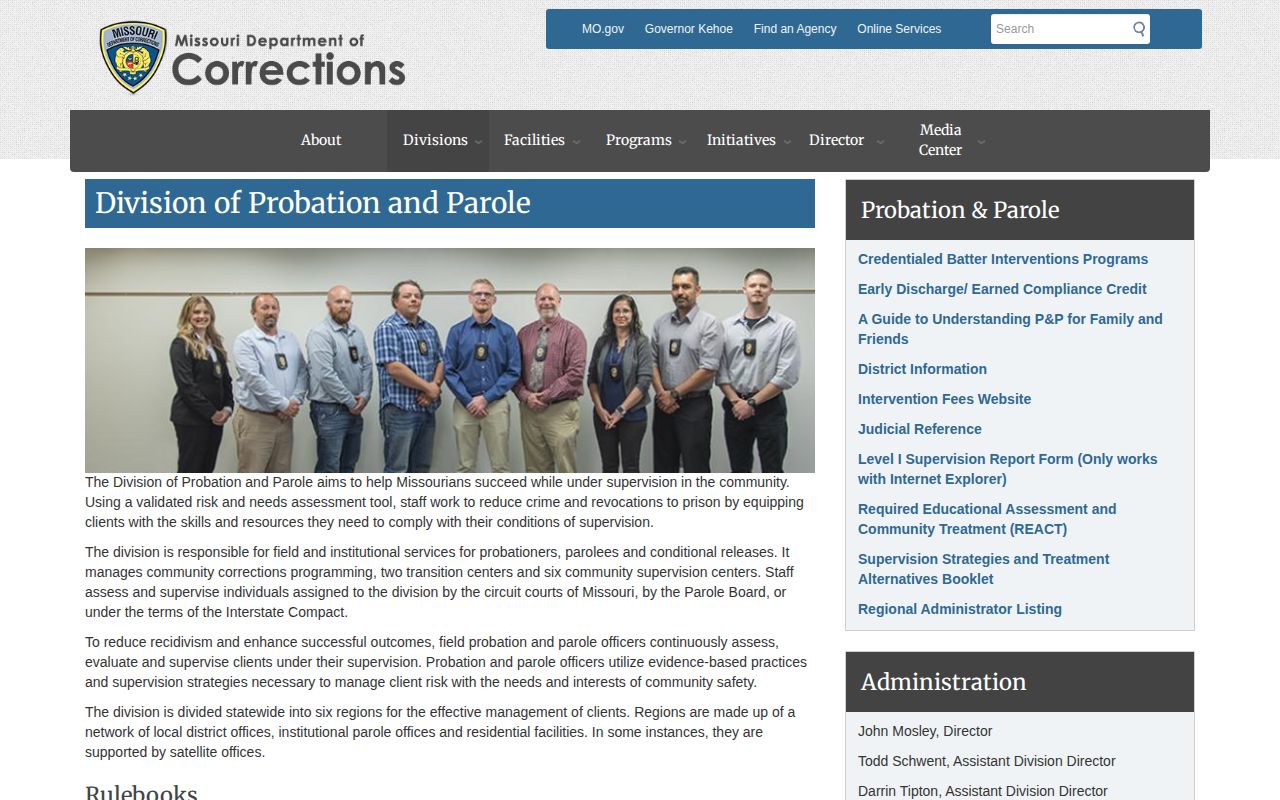
The screenshot identifies the correct state channel, while a person-specific assigned place determines which office should answer an individual question.
Why Pulaski Supervision Stays Searchable
A prison release does not always end a person’s MODOC relationship. This Pulaski County distinction is central: the active-offender search includes people supervised in the community. A field assignment may remain visible after the prison exit because parole, conditional release, or probation is still active. By contrast, a person who reaches final discharge is excluded from the public active search.
That split changes the fallback. For an active person, use the offender search and office directory. For a fully discharged person, use the MODOC Sunshine page and its FAK930 working data, or request a person-specific record. The working file includes a Completed Flag, probation date, probation type and term, assigned place, Field/Institution flag, cause number, sentence county, sentence date, and sentence minimum and maximum release dates. MODOC warns that working data may be incomplete or inaccurate, so a conflict should go to the record custodian.
This is the distinctive Pulaski County supervision path identified in Research Section 19, Angle R. It prevents a missing active result from being treated as proof that no parole, probation, or correctional history existed.
Pulaski County Violations and Absconders
Supervision conditions are person-specific. They may address reporting, travel, treatment, electronic monitoring, or other terms in the governing order, but no generic list can establish one person’s duties. The supervising officer, court order, Parole Board notice, and MODOC record control. A missed report or alleged breach can lead to a violation report, a change in status, or warrant action, yet each step must be stated with care.
An absconder designation generally signals an alleged failure to remain available to supervision. It does not establish a new conviction. It also does not prove the person has returned to physical custody. The division’s command center handles warrant information for absconders. Where immediate status matters, contact the supervising authority and distinguish an active warrant from an executed warrant.
MOVANS and the sheriff-linked Missouri VINELink route can report custody events or notifications, but neither is a permanent supervision ledger. A transfer or custody change may occur without community release. Compare an alert with the state record and the agency that supplied the event.
Note: A field status, warrant status, and physical custody status answer different questions and should never be collapsed into one label.
Pulaski County Parole Hearing Records
The Missouri Parole Board decides parole matters. The Board site did not provide a verified public person-by-person hearing calendar or searchable decision-results database at the research date. For a specific hearing date or outcome, contact institutional parole staff or the Board. A Sunshine request for Board records may be sent to ParoleBoard.SunshineRequest@doc.mo.gov.
An eligibility hearing is not a release order. The official parole hearing process explains that a decision may set a future release date or schedule another hearing from one to five years later. Decisions generally take about eight to twelve weeks. Outcomes can include a release scheduled subject to conditions, denial with another hearing, a deferral for more facts or programming, or later rescission when the authority and facts allow it.
Missouri Revised Statutes section 217.690 places parole decisions with the Board and calls for risk and need review and, ordinarily, a personal hearing. The statute contains sentence-specific rules. A generic fraction of a sentence cannot replace the current statute or person-specific notice.
Note: A hearing date marks review, not release, and only the person-specific Board notice states the decision and next step.
Ending Pulaski County Supervision
Discharge ends the active supervision relationship. It can occur after the full term, through a court action that shortens probation, through a Parole Board early discharge from parole or conditional release, or through Missouri’s Earned Compliance Credit process where the person and case qualify. This endpoint should be kept separate from the earlier release from jail or prison.
The official Earned Compliance Credit page says eligible compliant supervisees can earn thirty days of credit for each compliant month. Credit is not earned while the person is in custody or absconder status. A month with a violation report also does not earn credit. Exclusions and jurisdiction rules apply, including the requirement described by the state as twenty-four months. The program concerns supervision discharge, not prison good time.
Once discharge occurs, the person is no longer expected to appear in the active MODOC offender search. The historical route is the Sunshine data page or a focused records request. Ask for the discharge date and basis, and include enough identifiers to avoid a same-name mismatch. The broader Pulaski County release and records paths are covered on the home search page.
Read Pulaski Release Events in Order
One clean sequence keeps the records from being confused: confinement exit → supervision start → field-office assignment or transfer → early or full discharge. Not every Pulaski County case uses every step. A probationer may skip state prison. A person who finishes a brief county jail episode may have no MODOC supervision. A parolee may leave prison yet remain under active state authority for a long period.
Case.net explains the court’s judgment and later docket action. MODOC shows an active state relationship and the assigned place. The Division office confirms supervision administration. The Parole Board record explains parole decisions. Sunshine data or a focused request supplies historical discharge information after the active result is gone. Reading each source for its proper role gives a sound answer without turning one status into another.