
Pulaski County Projected vs Actual Release
A projected date is an administrative sentence calculation based on the information then on file. It can reflect a sentence, jail credit, minimum-term rules, conditional-release provisions, parole action, or other lawful inputs. The actual release is the event the custodial agency processes. Those points may match, but a projected date does not prove the person walked out of the Pulaski County Jail or a Missouri prison on that day.
Pretrial custody works differently. A detainee who has not been sentenced does not have a sentence-based projected release date. Release may depend on posting bond, a court order, dismissal, a change in charges, or another custody decision. Case.net can show the order or docket event, while the jail record shows the physical custody exit. A transfer to MODOC, another jail, USMS, or ICE is not a community release even though the person leaves the local facility.
For a sentenced state prisoner, distinguish eligibility from approval. A minimum date can relate to when parole, conditional release, or another lawful early-release path becomes possible. It does not direct the gate to release someone. A maximum date is the outer sentence calculation in the working data, still subject to lawful changes.
Find a Pulaski Projected Release Date
Start with the custody system, not with a broad name search. A recent Pulaski County booking points to the sheriff and the Pulaski court case. A Missouri DOC number or state prison sentence points to MODOC. State probation, parole, or conditional release also belongs in the MODOC channel, though those statuses concern supervision after confinement. Searching the wrong system can turn “not found” into a false conclusion.
- Determine whether the person is pretrial, serving a Pulaski County jail term, in a Missouri prison, or already under state supervision. Use the court case and known custody details.
- For active MODOC custody or supervision, search the MODOC Offender Web Search by DOC ID when possible. Compare identity, the data timestamp, assigned place, and Field/Institution context.
- For detailed sentence fields or a fully discharged person, use the MODOC Sunshine Law and data page. The FAK930 working file has sentence minimum and maximum release dates.
- For a Pulaski County jail sentence, call the jail at 573-774-6196 and ask for the calculated discharge tied to the named booking. Check the judgment and jail credit through the Circuit Clerk or Case.net.
- Near the expected date, confirm with the agency that holds the person. Ask whether the event is community release, a transfer, parole release, conditional release, or another disposition.
The active MODOC search excludes discharged offenders. A missing person may have reached full discharge, may be in a different custody system, or may require a historical request. For a person-specific MODOC record, email OD.SunshineRequest@doc.mo.gov with the DOC number, full name, date of birth if lawfully known, cause number, sentencing county, and the exact date fields requested.
Note: A DOC ID narrows same-name matches, but the record’s assigned place and data timestamp still need review.
Pulaski Release Date Field Names
Missouri’s official working data does not use one universal “projected release date” label. Its exact fields are Sentence Minimum Release Date and Sentence Maximum Release Date. That wording matters. The minimum field is linked to eligibility under the sentence and applicable law. The maximum field reflects the outer sentence calculation recorded in the data. Neither field is a promise of a precise release hour or destination.
The statewide FAK930 file also includes DOC ID, name, date of birth, assigned place, a Field/Institution flag, cause number, offense and sentence county, charge, offense, sentence date, sentence length, probation date and type, probation term, and a Completed Flag. A Completed Flag of Y means the sentence is completed. MODOC describes the file as working data from about 1974 forward and warns that it can be incomplete or inaccurate.
| Missouri field | What it helps answer | What it does not prove |
|---|---|---|
| Sentence Minimum Release Date | When an applicable early-release or eligibility point may arise | That release was approved or processed |
| Sentence Maximum Release Date | The recorded outer sentence calculation | A guaranteed gate date or time |
| Field/Institution | Whether the assignment points to field supervision or an institution | The full history of each custody transfer |
| Completed Flag | Whether the sentence is marked completed in the working data | A certified release record without confirmation |
The MODOC Sunshine data source displays the Pulaski County release-date fields in their official context.
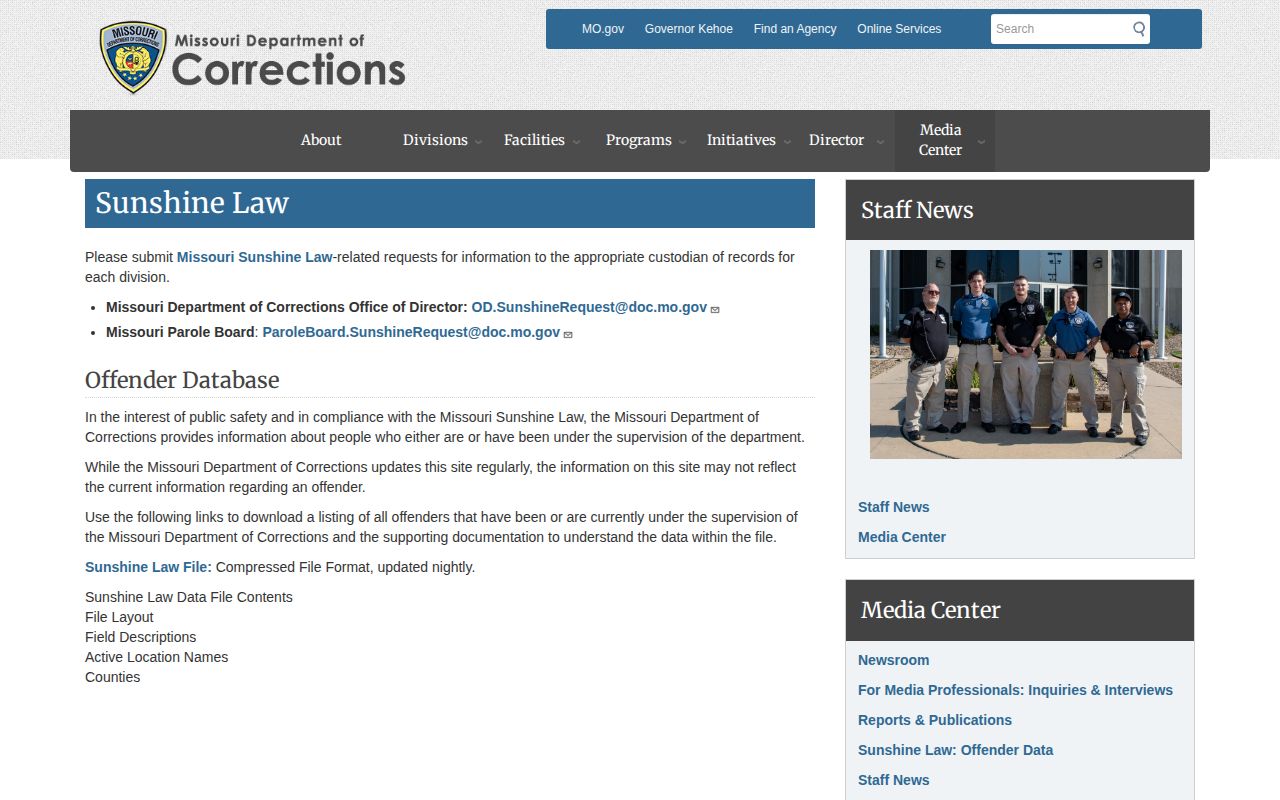
The source is useful for field definitions and historical working data, while an individualized MODOC record is the better route when two sources conflict.
Missouri Minimum Terms in Pulaski Cases
Missouri Revised Statutes section 558.019 is often reduced to an inaccurate slogan. Its 85 percent minimum is not a rule for every Missouri prisoner. Subsection 3 applies to a person convicted of a dangerous felony as defined by Missouri law and requires at least 85 percent of the court-imposed sentence, or until age seventy after at least 40 percent has been served, whichever occurs first.
Other covered cases can involve minimum terms of 40, 50, or 80 percent under subsection 2 for specified repeat prison commitments and offenses. The statute has definitions, exclusions, and procedural terms. It defines a minimum prison term as the time required before eligibility for parole, conditional release, or another early release by the Department of Corrections. Eligibility still is not approval.
The parole statute puts release decisions with the Missouri Parole Board. The Board uses risk and need information and ordinarily conducts a personal hearing. Its guidance and a minimum date do not guarantee release. Consecutive sentences can also affect eligibility under the governing rules.
Section 558.011 describes imprisonment terms and conditional release. Conditional release means supervised release under conditions, not the end of all correctional authority. That is why a Pulaski County projected release date, the first day in the community, and final discharge may appear as three distinct milestones.
The official section 558.019 statute page shows the rule that must be read in full before applying a percentage to a Pulaski County sentence.
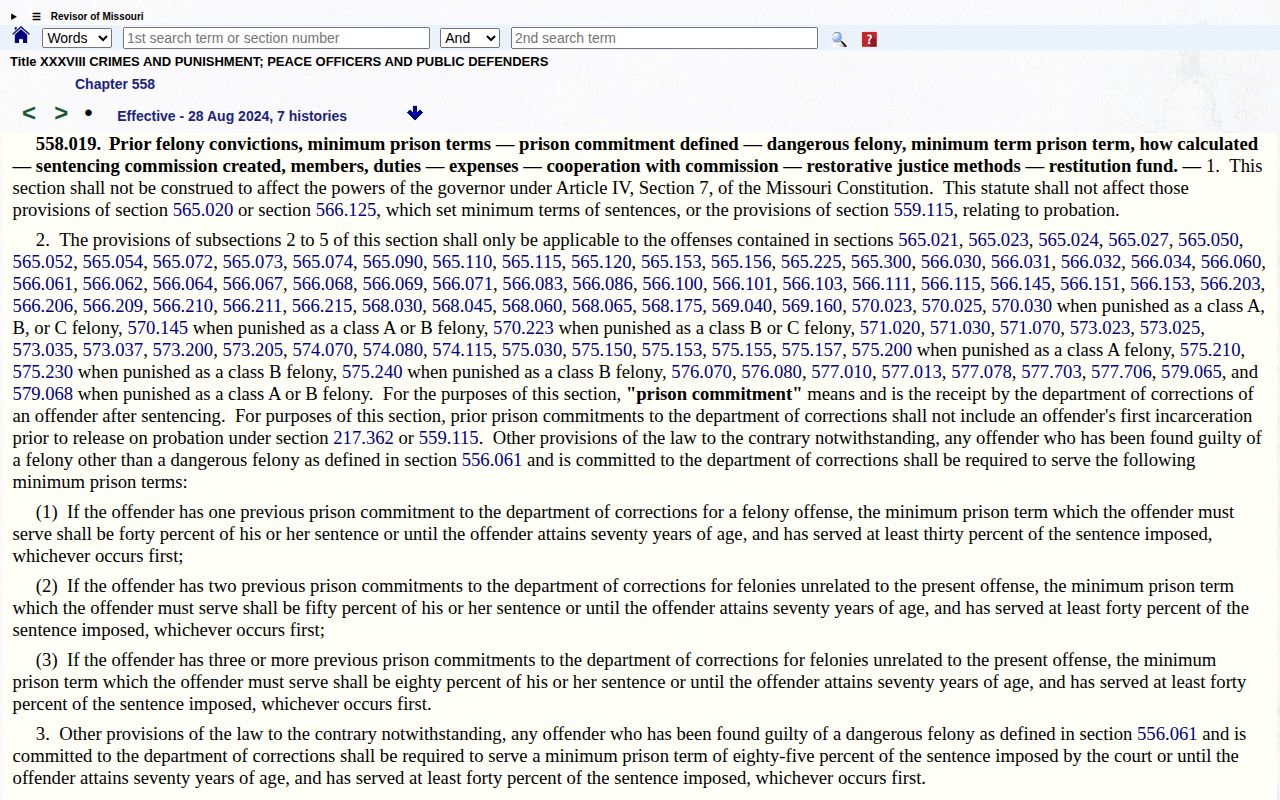
The statute supplies the legal framework, while the person-specific judgment and MODOC calculation supply the facts for one sentence.
Note: A statutory minimum term sets eligibility limits; it does not establish the date that the agency will process release.
Pulaski County Jail Release Calculations
A Pulaski County jail sentence cannot be calculated from MODOC’s prison fields. The local answer depends on the court judgment, credit for time already served, the sentence terms, and the jail’s lawful processing. The research did not verify a public Pulaski-specific good-time schedule. It also found no verified Pulaski weekend or holiday release rule. Any arithmetic that assumes either rule would be invented.
Ask the Pulaski County Jail for the calculated discharge tied to the named booking. Ask the Circuit Clerk for the judgment and any later order that changes the sentence or jail credit. Missouri Case.net can help locate the public case header, charge, docket, judgment, bond, and sentence entries, but a court entry does not establish the minute the physical release occurred.
This county-versus-state split is the distinctive finding in Research Section 19, Angle O. Missouri’s Sentence Minimum Release Date and Sentence Maximum Release Date belong to state corrections working data. The judgment and sheriff calculation control a Pulaski County jail term. Keeping those systems apart prevents a state minimum term from being copied onto a local jail stay.
- Jail credit
- Time credited toward a sentence under the governing judgment and law.
- Detainer
- A request or authority from another agency that may affect what happens when the current custody episode ends.
- Conditional release
- A supervised release from a Missouri prison under conditions, not final discharge from MODOC.
Note: No verified Pulaski County good-time formula or weekend-release policy appears in the project research, so the jail must confirm the calculation.
Why Pulaski Release Dates Change
A displayed release date can change when the facts or legal inputs change. Some changes alter eligibility. Others alter the sentence calculation, custody destination, or actual processing. Preserve the date on which a record was viewed, then verify again near the expected event.
| Factor | Possible effect on the release date | Best confirming source |
|---|---|---|
| Jail-credit review | Changes time credited to the sentence calculation | Judgment, later court order, jail, or MODOC sentence detail |
| Concurrent or consecutive sentences | Changes how terms combine and when eligibility occurs | Court judgment and MODOC record |
| Appeal or amended judgment | Can revise sentence terms or custody authority | Case.net docket and filed order |
| Parole action | Can schedule release, deny release, defer a decision, or set another hearing | Missouri Parole Board notice |
| Revocation or violation action | Can interrupt community supervision and affect the sentence path | Court, Parole Board, and MODOC |
| Detainer or new case | Can turn a facility departure into a transfer rather than community release | Holding agency and receiving authority |
| Escape or absconder time | Can alter credit or sentence administration under applicable rules | MODOC and governing order |
A data correction can also move a date without a new court event. MODOC’s warning about incomplete or inaccurate working data makes direct confirmation essential when an online value conflicts with a judgment or an agency notice.
Pulaski Release and Supervision Discharge
Prison release and supervision discharge must not be merged. A person may leave prison on parole or conditional release and remain searchable as an active MODOC offender because the public search includes community supervision. Final discharge occurs later and ends that active state relationship. A probationer can also be under MODOC supervision without first serving a state prison term.
Missouri’s Earned Compliance Credit program addresses early discharge from probation, parole, or conditional release. The official early-discharge page says an eligible compliant supervisee may earn thirty days of credit for each compliant month. Credit is not earned during custody or absconder status, and a month with a violation report does not earn credit. Exclusions and jurisdiction rules apply, including the state’s described twenty-four-month requirement.
Those credits are not prison good time and should not be subtracted from a projected prison release date. A court may shorten probation, the Parole Board may grant early discharge from parole or conditional release, and the division may discharge through Earned Compliance Credit where the law applies. The records should therefore be read as a timeline: confinement release, supervision, then discharge.
Confirm a Pulaski County Release Date
Confirmation should happen close to the expected event. For a Pulaski County jail term, call the jail and compare its calculation with the court judgment. For a Missouri prison term, compare the active offender record, sentence-detail data, and any Parole Board notice. If the person has fully discharged and no longer appears in the active search, make a focused Sunshine request.
MOVANS can provide current Missouri status and subscription alerts. The Pulaski sheriff still links to Missouri VINELink, while the state now runs MOVANS as its current public portal. An alert is evidence that a reporting agency sent a custody event, but it is not a certified historical ledger. It also may not explain whether the event was community release or transfer. The dedicated VINELink Inmate Search page explains the current and legacy notification paths.
Ask one final, precise question: did the holding agency process a community release, or did another authority assume custody? That answer closes the gap between a projected date and the real-world outcome.